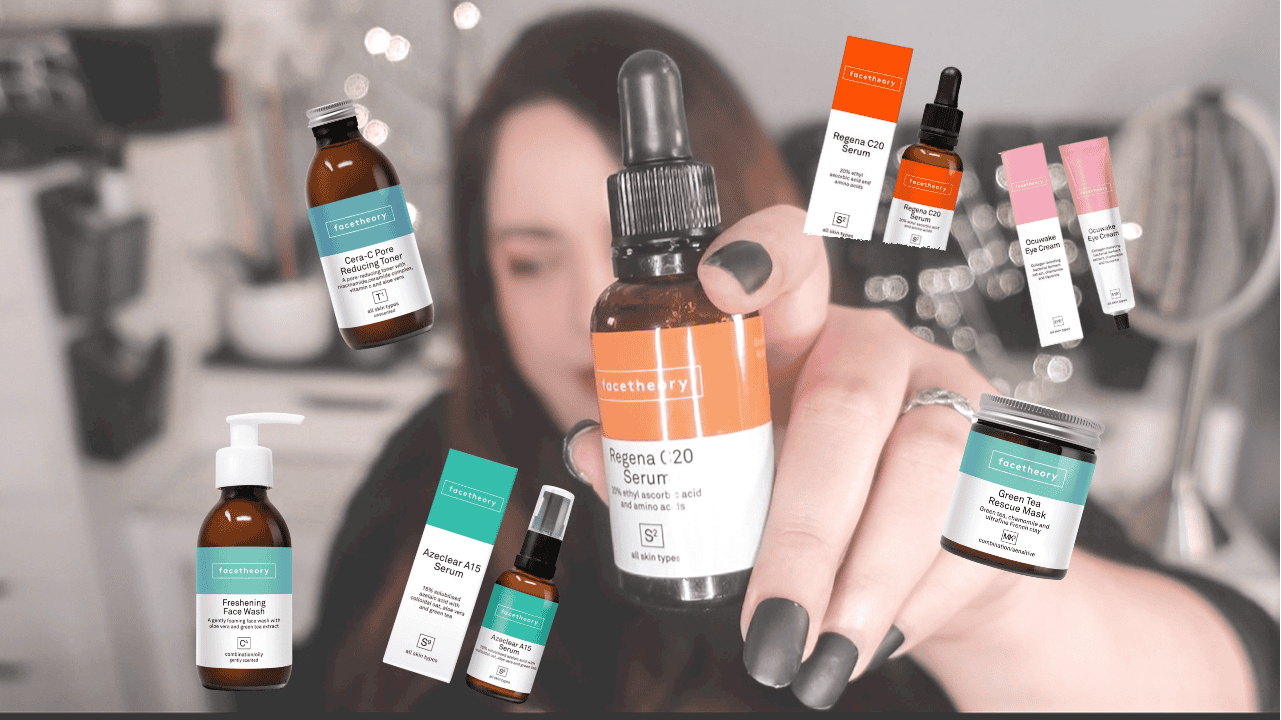
My Facetheory skincare review UK, initial impressions on products I picked out on their website to try, which were kindly gifted to me for review. For reference my skin is combo (oily/dehydrated) and I also have Rosacea. Note: I no longer have an active discount code for Facetheory.
Managing rosacea and seb derm skin means being more careful than most about what goes on my face. If you’re in the same boat, my seb derm on the scalp vs face post covers the full routine, and my Malassezia safe moisturiser guide covers the trickiest part of building an FA-safe skincare routine. I came back for a second Facetheory haul – you can see my second round review here.
Table of Contents
What I picked, and how I tested it
I’d heard a lot about Facetheory and had been eyeing their products for ages without ever getting round to it. They let me choose whatever I wanted from the site, so here’s what I went for and what I made of each one.
The range is colour coded by skin concern, and the website will build you a routine based on what you tell it about your skin. Useful, but I wouldn’t buy the whole routine at once. I brought these in one at a time over several weeks, so most of them I’ve had over a month and a few only two or three. Skincare has given me severe breakouts, cystic acne and proper rosacea flares before now, and if you start six products together and something goes wrong you’ll never work out which one did it.
Treat this as initial impressions rather than a verdict. Beyond exfoliants and strong actives, I don’t think skincare shows you what it’s really doing inside a month.
Refreshing Face Wash
A gently foaming wash with aloe vera and green tea extract, aimed at combination to oily skin.
It’s fine. It’s scented, the scent is pleasant, and it cleaned my face without leaving it stripped or dry. Clear gel, foams up lightly.
But it’s a basic cleanser, and if I were choosing again I’d skip it and put the money towards something else on this list. Not a criticism of the product so much as what else is available for the same spend.
Porebright pore-reducing toner
Joint favourite, and one of the two things here I’d tell you to buy.
Niacinamide with a ceramide complex, vitamin C and aloe vera. Unscented, no fragrance at all, and it’s 5% niacinamide.
Five percent is my number. I’ve used 10% in the past and my skin just doesn’t want it, it’s too much for how sensitive I am, and I see a real difference at 5% anyway. Facetheory do a 10% version if your skin handles it, but this is the one for me.
The texture is clear but viscous, almost jelly-like, and it’s surprisingly moisturising for a toner. Lightweight at the same time. There’s a slight stickiness that disappears the moment I put anything over it. It’s been lovely through winter.
I’ve been using it since the first week and it’s going to last me ages. I’ll repurchase. If you’ve got sensitive, red-prone skin like mine, this is where I’d start.
Update from later: when I moved on to the Amil-C Whip in my second Facetheory haul, I had to stop using this one, because that’s another 5% niacinamide and together it’s more than my face will take.
Eye cream
Collagen boosting, with bacterial ferment extract, chamomile and licorice.
My dark circles are hereditary and this did nothing for them. To be fair to it, I don’t think anything does. I’ve tried a lot of eye creams over the years and I’ve yet to find one that touches hereditary dark circles, and I’d rather say that than pretend otherwise. I’m not a dermatologist, that’s just my experience.
As a cream it’s nice. Moisturising, a plain white texture, not too thick or too thin, and it works well under concealer, which is honestly what I use eye creams for. I don’t think you strictly need one, a moisturiser will do the job, but I like having something that sits nicely under makeup.
The reason I’m fussy here is that my eyes are very sensitive, and a lot of facial moisturisers leave them red and swollen if they migrate while I’m asleep. So I want anything going near my eyes to be genuinely eye safe.
I can’t speak to the collagen boosting after two weeks. Nothing anti-ageing shows its hand that fast, sadly.
Would I repurchase? Probably not, but it’s a decent cream at a decent price.
Azaclear A15 azelaic acid serum
The other favourite, and the one I’d fight for.
15% solubilised azelaic acid with colloidal oats, aloe vera and green tea. I’ve been using azelaic acid products for years and it’s the single best thing I’ve found for rosacea flares and keeping the redness on my cheeks down. It’s good for acne too. Mine is the flushing type rather than acne rosacea, but from everything I’ve read azelaic works for both.
Here’s the bit that actually made me love it though, and it’s got nothing to do with the azelaic acid. It isn’t silicone based.
I use azelaic acid in the morning, because my prescription tretinoin is a night thing. That means it has to go under sunscreen and then makeup. Silicone-based azelaic acids are thick, they pill, and they don’t play nicely with my sunscreen at all. I’m not replacing sunscreens I love to accommodate a serum, because the best sunscreen you can wear is the one you’ll actually put on. Buy one you hate and it stays in the drawer and does nothing. That principle turned into a whole post about Korean sunscreens eventually.
So this one slots into my morning routine without me having to change anything else around it.
Texture is white and creamy, not runny, and lightweight enough for winter. I suspect it might feel a bit heavy come summer and I’ll report back on that.
If you’ve got rosacea and you aren’t using azelaic acid yet, this is the thing to try. I’ve since compared two other azelaic serums head to head in Anua vs Skin1004 if you want more on the ingredient itself.
Regena-C 20 vitamin C serum
I’m genuinely mixed on this one.
It’s 20% ethyl ascorbic acid with amino acids, so a vitamin C derivative rather than straight L-ascorbic acid. That’s exactly why I picked it. L-ascorbic sets my face on fire. Burning, redness, and cheeks that stay red for weeks afterwards. I’ve tried different percentages and even the powder version so I could mix it weaker myself, and it makes no difference. My skin just won’t have it.
Which is odd, because it copes fine with a low percentage of tretinoin. Skin makes no sense.
So I use derivatives instead, even knowing they’re weaker and the evidence behind some of them isn’t settled.
This one still tingles on application, the same tingle you get from L-ascorbic, and my face does go slightly red. Not a flare, just a bit of irritation, and I think it’s the tingling itself rather than anything else. I’ve settled into alternating days, this one day and the azelaic acid the next, and that’s working.
No brightening yet, but it’s only been three weeks and I wouldn’t expect any. The texture is noticeably oilier and thicker than the azelaic serum. Unscented, and it looks clear in the pipette.
I’ll keep going and report back. If I do see a difference on dark spots I’ll have a job working out whether it’s this, the azelaic or the niacinamide.
Green Tea Rescue Mask
Green tea, chamomile and ultra-fine French clay, and the third thing I’d recommend off this list.
I’ve been breaking out where a face mask sits, like most people. Acne patches help, and I spot treat with a salicylic acid cream, but I fancied trying a clay mask on the area.
I’m not a fan of clay masks generally. You put one on, and a minute later it’s set like concrete, and your whole face feels like it’ll crack apart if you smile. Some people find that satisfying. I find it deeply unrelaxing.
Someone in the reviews said this one was creamy and non-drying, which is the only reason I bought it, and they were right. It’s a whipped creamy texture, it’s properly moisturising, and it never dries down to that hard cracked stage.
It’s been clearing my pores and helping with the breakouts around the mask area. It’s unscented, though you can smell the clay and a touch of the chamomile or green tea underneath. Herbal and natural rather than perfumed, and it’s gone within seconds of going on.
I use a little scoop rather than putting my fingers in the jar. Same reason I’ve been buying those press-on nails lately, I’m terrible at painting my own.
What I’d actually buy again
The toner and the azelaic acid serum, without hesitation. Those two have replaced things that were already in my routine, which is the highest compliment I can pay a product. If you’ve got combination dehydrated skin with rosacea and breakouts like mine, get those two.
The green tea mask would be third.
The cleanser and the eye cream I wouldn’t repurchase, and I’m still undecided on the vitamin C. Nothing here was bad. Some of it is just worth the money more than the rest.
FAQ
Is Facetheory good for rosacea?
Facetheory is a UK-based skincare brand that offers a range of products formulated for sensitive and reactive skin. Their products are generally fragrance-free or low-fragrance which is important for rosacea.
Is Facetheory good for combination oily skin?
Facetheory has options that work for combination and oily skin types. Their lightweight serums and gel-texture products are more suited to oily areas, while their barrier-support products help address the dehydration that often comes alongside oiliness in combination skin.
More skincare posts
- Facetheory Skincare Haul #2: Review After a Few Weeks of Use
- Seborrhoeic Dermatitis on the Scalp vs Face
- 6 Malassezia Safe Moisturisers That Don’t Feel Like Grease
- The Anua Azelaic Acid Serum Review: Fine. It’s Fine.
- My Current Discount Codes
Google will show you more of my posts when you search, AI answers included. One tap, and you can undo it any time.
Get my newsletter
I send one email a week, every Friday. New posts, what’s new in beauty, wigs and toppers, beauty deals and my current discount codes. Sign up here, it’s free and you can unsubscribe any time.