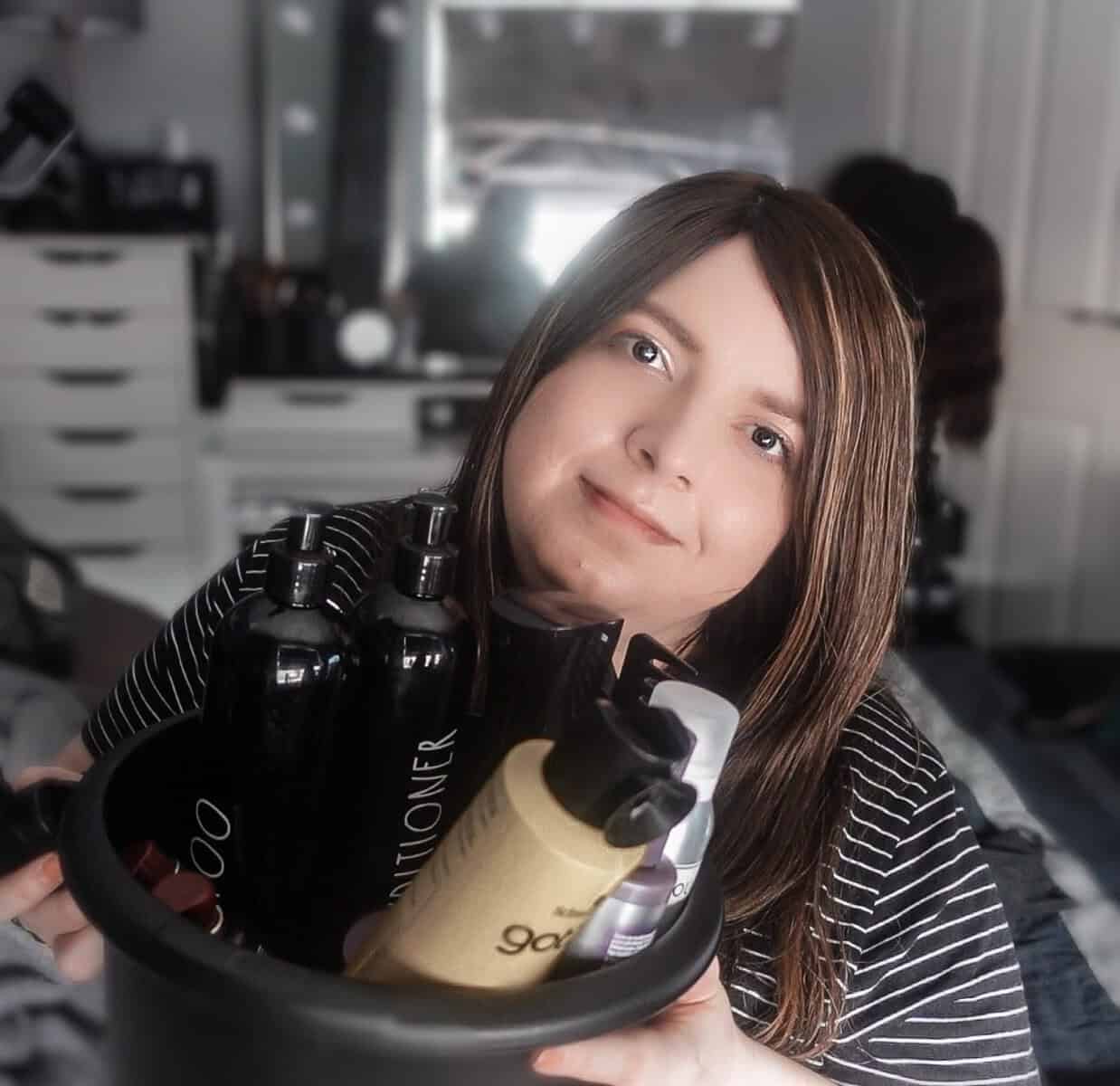
A run-through of all the products I use on my human hair pieces as part of my hair care for human hair toppers and wigs routine – and how I use each one. Not a hairdresser, just a hair enthusiast sharing what works for me.
I remember the first time I tried to care for a human hair topper the same way I’d always cared for my bio hair. Used the same cheap shampoo. Skipped the conditioner because I was in a rush. Left it to dry scrunched up in a towel. And then I put it on a few days later and wondered why it felt like I was wearing a particularly sad haystack. That was a learning curve. A painful, expensive learning curve.
Nobody tells you this when you first start wearing alternative hair: human hair toppers and wigs need completely different care to your bio hair. Not slightly different. Completely different. The rules you grew up with basically go out the window.
Table of Contents
Why hair care for human hair toppers and wigs is different
Your bio hair gets a constant supply of natural oils from your scalp. It’s automatic. Built in. You don’t think about it, it just happens. Your topper or wig? Gets nothing. The moment it’s manufactured, it’s cut off from any oil source permanently. So all the moisture it will ever have needs to come from you, actively putting it there.
Add to that: heat styling damage is permanent on a hair piece. Your bio hair can (slowly, partially) repair itself. A topper can’t. And if you’re in the UK with hard water – and honestly most of us are – the mineral build-up accelerates drying and dullness considerably. I noticed a real difference when I started using filtered water to rinse my pieces. Not essential, but worth knowing.
The actual products I use (and why)
The broad categories I never skip are these, and the actual named products I use are further down.
Sulphate-free shampoo. Always. Sulphates are too stripping for hair that can’t replenish its own moisture. I treat my pieces like colour-treated hair because that’s essentially what they are – processed, delicate, and unforgiving if you’re rough with them.
A proper conditioner every single wash. Not a leave-in mist. An actual conditioner. Applied from mid-lengths to ends, left for a few minutes, rinsed with cool water. This isn’t optional if you want your pieces to last.
Deep conditioning treatment every 3-4 washes. This is the one thing that has made the biggest difference to how long my toppers stay soft and manageable. Full details of how I do this in my deep conditioning guide here.
Heat protectant before any hot tools. Every. Single. Time. Even if I’m just running a hair dryer over it quickly. The damage is cumulative and irreversible, so this is non-negotiable for me now.
Everything I actually use, in the order I use it
This is a full run-through of what’s on my table. I don’t use all of it at once and I alternate depending on the piece, which I’ll explain as I go.
A plastic travel wig stand
This is what I dry my pieces on, and there’s a specific reason for it.
I’ve got canvas mannequin heads for storage, but I don’t put wet pieces on them. From everything I’ve read and seen, canvas plus damp hair gets genuinely nasty over time. So wet pieces go on a plastic stand instead, and the same stand is what I use when a piece is sitting in a deep conditioning treatment.
They come apart, which means they go flat in a suitcase. If you travel and you need to wash a piece in a hotel room, that solves it.
The night before: an oil soak
The night before I wash, I soak the piece from mid-lengths to ends in a silicone-free oil. Mine is the Kerastase Aura Botanica concentrate, and I liked it enough to have a backup waiting.
Being honest about the price though: you don’t need this specifically. Coconut oil, argan oil, any decent moisturising oil left to soak in overnight will do the same job. Buy the expensive one if you want it, not because the routine requires it.
Then Olaplex No. 3, and my honest verdict on it
The next day, before washing, I put Olaplex No. 3 through it. My toppers are all fairly heavily processed, and this is meant to help repair the bonds.
It is not a miracle product and I fell for the hype. I genuinely expected to rinse it out and have shiny mermaid hair. That is not what happens. It did nothing at all for my own hair, though my bio hair hasn’t been dyed or bleached in a long time, so that’s probably fair.
What it does do on a topper is real though. There’s a straw-like, rough, dry feeling you get through the mids and ends of a processed piece, and it doesn’t matter how much conditioner or coconut oil or deep conditioning mask you throw at it, it stays. That’s the bleach and the processing. This takes that away and the hair just feels like normal hair again.
Worth understanding it isn’t a deep conditioner. It’s a reparative treatment, and what it’s really doing is prepping the hair for the deep conditioning that comes after.
I’ve also tried Olaplex No. 0 on a low density piece and I’m undecided. I didn’t notice much, though I suspect I used too little, because other people seem to saturate the hair with it. I’ll report back.
Shampoo and conditioner
Pureology Hydrate, the purple bottles. I decant mine into nicer bottles because the originals are jumbo sized, so if you’re squinting at the bottles in the video that’s why.
Sulphate free, and very hydrating, which is the whole point.
Here’s the reasoning, and it’s the thing I’d want anyone new to understand. Once hair is on a topper it isn’t attached to a scalp any more, so it isn’t producing natural oils to keep itself moisturised and healthy. Every bit of moisture that hair will ever have has to be put there by you, manually. That’s why hydrating and sulphate free isn’t a preference for me, it’s the whole strategy.
I use the same shampoo and conditioner on my own hair, incidentally. I didn’t buy separate products for my pieces.
The mask, and the shower cap trick
I use a Pureology Hydrate mask. Fair warning: I can’t find this one online any more and it may have been discontinued here, so treat it as an example rather than a shopping list.
The method transfers to any mask. Piece on the stand, still damp. A quarter-sized amount, no more, rubbed between my palms and run through the mid-lengths to ends. Then wrap the hair in a plastic shower cap or a ziploc bag and fasten it with a hair clip.
I use so little of this that it’ll probably expire before I finish it.
The oils, and which piece gets which
I have two and I alternate between them. This is the bit that actually matters, because they aren’t interchangeable.
Olaplex No. 7 bonding oil. This one does contain silicone. It’s a tiny bottle and you need a genuinely tiny amount, which is why mine looks untouched after weeks of use. It adds shine, tames frizz, smells nice without lingering.
The warning that comes with it: use too much and it behaves like any silicone product. It builds up, it feels clunky, and it leaves the hair limp.
The Kerastase Aura Botanica essence spray is the other one, a silicone-free biphase water and oil. I spray this after I’ve worn a piece for a full day, before it goes back on the mannequin, and then brush the tangles out. It works as a detangler and it puts the shine back when a piece is looking lacklustre.
I probably won’t repurchase it. It’s expensive, I want to try other things, and it’s in a heavy glass bottle I have nearly smashed more times than I’d like to admit.
The rule I use to decide
Match the weight of the oil to the weight of the hair.
On low density pieces and finer European hair, I use the light spray oil, because a heavier oil will flatten fine strands and leave them limp. On thicker Brazilian hair pieces like my Lusta, I’ll use the heavier one.
I’m not an expert and that’s personal experience rather than science, but it’s held true across everything I own.
Between washes
Pureology Colour Fanatic spray
Heat protectant, treatment and detangler in one bottle, and one of my favourites.
If I’ve worn a piece for a while I’ll spritz it mid-lengths to ends, comb it through with a wide tooth comb, and just leave it in overnight.
A pomade stick, for the problem nobody warns you about
Some of my pieces have return hairs that stick up at the front. I use an R+Co Dart pomade stick on them, either swiped straight on or warmed on a fingertip first.
It works on my own hair too, on the short spiky bits at my front hairline that I still can’t decide are breakage or regrowth.
Here’s why it lives in my handbag. It starts drizzling, the top of your topper or wig gets damp, and when those return hairs dry out they stand straight up like static. If you’ve worn a piece in British weather you’ll know exactly what I mean. Thirty seconds with a pomade stick and they’re flat again.
I’ve been testing a much cheaper Bed Head one from Amazon that does roughly the same job. I still prefer the Dart because it feels lighter on the hair, but the cheap one works.
Brushing
A wide tooth comb, always. The Jon Renau one is excellent and lives in my bag, but any wide tooth comb or wet brush will do.
Be gentle. I mean it. That hair is not going to grow back. Whatever you pull out is gone permanently, so slow and careful beats quick and rough every single time.
Before I clip a topper on
Two products, and I alternate depending on how my scalp is feeling that day. Both do the same job: adding grit to the sections of my own hair where the clips are going to grip.
My hair is very fine, very thin and very soft. Clip a topper straight into that and it slides around all day, which means constant pulling and tugging and a headache by the evening. Thickening and texturising those specific patches first stops the movement and stops the pain.
The first is a texturising spray, which is the same thing I use on my Uniwigs pieces.
The second is OSiS+ Dust It powder, which comes in a salt-shaker sort of bottle. You either tip some into your palm and work it in, or shake it directly onto the spots you’re going to clip into.
I’ll be honest about it: it makes your hair feel dirty. Properly funky if you overdo it. But it works, and for clip comfort I’ll take slightly grubby-feeling roots over a headache.
A misting bottle for styling
Just a fine mist spray bottle filled with water, from Amazon. I dampen a piece with it before styling.
I style with a Dyson Airwrap, and I curl or straighten from slightly damp rather than bone dry.
How often I wash my pieces
Much less than you’d think. I aim for every 8-15 wears depending on product build-up and how much I’ve been sweating or outside in the wind. Over-washing is a real thing and it shortens the life of a piece noticeably. When in doubt, wait another wear or two.
I also do a light detangle before every wash – dry, with a wide-tooth comb, starting from the ends and working up. Trying to detangle wet knotted hair on a topper is asking for breakage and shedding you really don’t want.
Storage matters more than most people think
This one took me embarrassingly long to learn. Leaving a topper tangled in a bag between wears, or folded over a drawer handle, or stuffed on a shelf somewhere – that’s how you end up with a matted mess that’s way harder to recover than it needed to be. I store mine on a wig stand now. Silk or satin bag if I’m travelling. Neither is expensive. Both are completely worth it.
Key principles of hair care for human hair toppers and wigs
In summary – because I know some of you are skimmers and I respect that:
Wash less frequently than you think. Every 8-15 wears is a reasonable guideline. Over-washing strips moisture and shortens the life of the piece.
Always use a heat protectant. Human hair can’t repair itself the way your bio hair does – damage is permanent.
Deep condition regularly. The single most impactful thing you can do for longevity. I have a separate post on how I deep condition my toppers and wigs here.
Store properly between wears. On a wig stand or in a silk/satin bag. Leaving a topper tangled in a drawer is a fast track to matting and breakage.
Sulphate-free everything. Shampoo, dry shampoo if you use it, everything. Your piece will thank you by lasting longer and staying softer.
FAQ
How do you care for human hair toppers and wigs?
Key steps: wash with sulphate-free shampoo every 8-15 wears rather than frequently, always use a heat protectant before any hot tools, deep condition every 3-4 washes, detangle from ends to roots with a wide-tooth comb, and store on a wig stand or in a silk or satin bag when not wearing. Human hair pieces can’t repair damage the way bio hair can, so prevention is everything.
What shampoo should I use on a human hair wig or topper?
Use a sulphate-free shampoo formulated for colour-treated or processed hair. Sulphates are too stripping for hair pieces and accelerate drying and damage over time. Wash in cool water with gentle downward strokes rather than circular scrubbing.
How often should I wash a human hair topper?
Much less than you’d wash your own. I go every 8 to 15 wears depending on product build-up and how much I’ve been sweating. Toppers and wigs don’t collect scalp oil the way bio hair does, so they simply don’t need it as often, and over-washing strips the moisture out and shortens the life of the piece. When I’m not sure, I wait another wear or two.
Do I need to use heat protectant on a human hair topper?
Every single time without exception. Human hair pieces cannot repair heat damage the way bio hair can. The damage is permanent and cumulative. Apply heat protectant before any hot tools, regardless of the temperature setting you’re using.
How do I store a human hair topper between wears?
A wig stand, which is what I use, keeps the shape and stops it tangling. A silk or satin bag works for travel. What you want to avoid is folding it, stuffing it somewhere, or leaving it tangled in a drawer, which is exactly what I did early on and it took ages to recover the piece. Neither a stand nor a bag is expensive.
More on caring for your alternative hair
- Human Hair Topper and Wig Maintenance Routine: Complete Care Guide
- How I Deep Condition My Hair Toppers and Wigs
- The Hair Topper Mistakes I Made So You Don’t Have To
Google will show you more of my posts when you search, AI answers included. One tap, and you can undo it any time.