A brand sent me a sunscreen with peppermint oil in it.
Peppermint oil. In something you put on your face. In the morning. Before the sun. I sat there holding the bottle and genuinely wondered if anyone at that company had ever met a person with sensitive skin, or if the whole product was a bet nobody thought I’d call.
That’s kind of the thing with Korean sunscreen. The textures are miles ahead of most of what I can buy on the high street here, the formulas are lighter, the finishes are better, the filters are ones the US still hasn’t approved. And then every so often you turn a bottle over and find something in there that makes no sense at all for the skin it’s being marketed to.
So I did the boring thing. I sat down with ten sunscreens, nine Korean and one Japanese that I’ll explain later, and read the ingredient list on every single one, properly, all the way to the end.
Eight of these I’ve bought and worn, and they all wore well on me. Some better than others. Two of them I haven’t worn at all, and I’ve said so clearly in the table and again underneath it. But how they felt on my face isn’t really what this post is for, because “it felt nice on me” is worth almost nothing to you when your skin is different from mine. What’s worth something is what’s actually in the bottle.
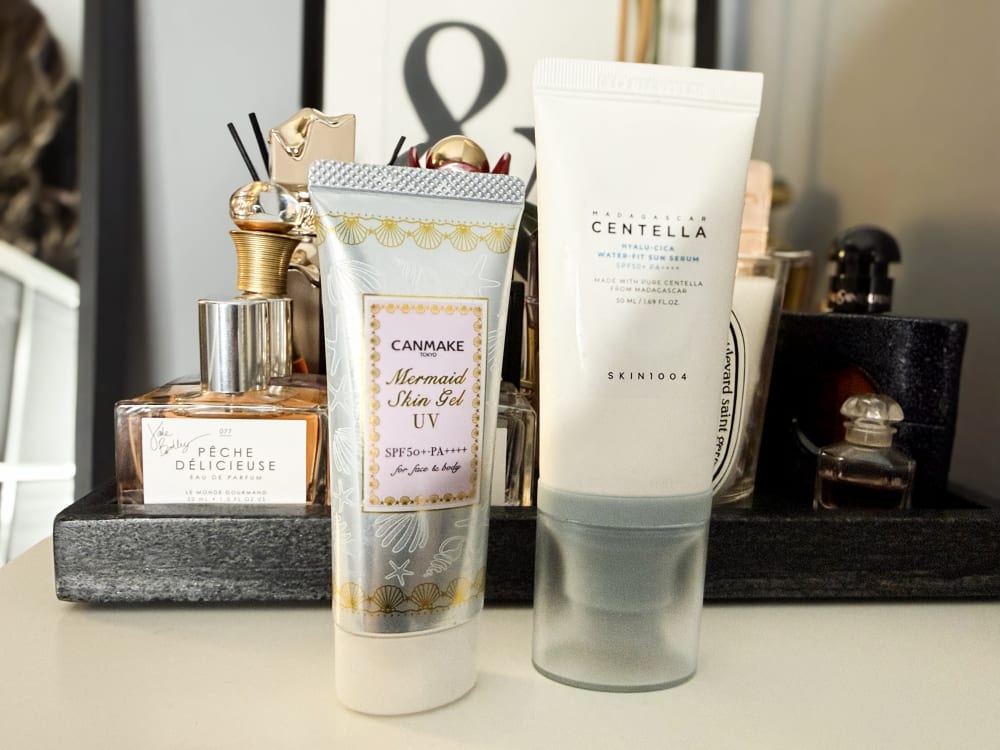
I should be straight with you about one thing, though, because it explains the photos. I don’t still own most of these. I rotate. Reviewing sunscreen means that when I finish one I buy a different brand, or I open something that’s been sent to me, and the whole point is to keep trying new formulas rather than build a collection. As I’m writing this there are exactly two of this list on my shelf. The ones that didn’t suit me went to friends and family, and I hang onto a few so I can compare textures side by side when something new turns up.
At 43, with rosacea and seb derm, I’ve stopped buying sunscreen on vibes.
Last updated: August 2026. Formulas change and brands reformulate quietly – always check the current INCI before buying.Quick disclaimer: I’m not a dermatologist. I’m someone with rosacea and seborrhoeic dermatitis who has spent years and a lot of money working this out. This post contains affiliate links and my own discount codes, which means I earn a small commission if you buy through them. It costs you nothing extra and it doesn’t change what goes on this list.
Why Korean sunscreen is genuinely different (it’s the filters)
Korea has been using UV filters the US still won’t approve. Uvinul A Plus, Uvinul T150, Tinosorb S and M, the Mexoryls. They give high protection without the weight and the cast that older filters produce.
Now, I need to clear one thing up, because I had it wrong myself for ages. Those filters are all perfectly legal here. They sit on the same approved list the EU uses and the UK kept. It’s America that’s the odd one out. So the gap isn’t what we’re allowed to have, it’s what our high street actually bothers to put in a bottle.
That’s the whole reason a Korean SPF50 can feel like a serum while a drugstore SPF50 sits on your face like emulsion paint. And it isn’t that these filters are some exotic import, either. European formulators have had the same ones to work with for about twenty years, and the French pharmacy brands use them properly. Korean brands just went further with them, faster, and put them in bottles that cost a tenner. It’s the Americans who are stuck, and I say that as one.
What that means practically: you’ll reapply. Which is the only bit that ends up mattering. Lab numbers are lovely, but a sunscreen that makes you hate your own face by 2pm is one you’ll quietly stop putting on, and the one you skip protects you from nothing.
Ten sunscreens in, here’s what I actually found
I sat down expecting to write a nice tidy list. Here are the good ones, here are the ones to skip, off you pop. That is not how it went.
Behenyl alcohol is in almost every Korean sunscreen I opened. It’s the standard thickener in the category. It’s a C22 fatty alcohol, which puts it inside the C11-C24 range Malassezia is documented to feed on. On the strictest reading, that alone disqualifies nearly the entire category.
Ten sunscreens. Not one of them passes a strict screen.
Now, I do think that’s too strict a reading, and I’ll get into why further down rather than pretending I didn’t notice. But the headline holds up. If you’re holding out for the perfect Korean sunscreen with a spotless ingredient list, I have bad news and it’s going to take a while.
And here’s the annoying bit. The reason these things feel so good compared to what I can get in Boots is the emollients and thickeners in them. That’s the whole trick. Those are also the exact ingredients on the naughty list. You can’t have the texture without the stuff that makes the texture.
I’d rather tell you that than pad out a top ten.
Not all flags are equal, and this is where most lists go wrong
Every fungal acne list works off the same biology. Almost every Malassezia species can’t make its own fatty acids, so it takes them from whatever you put on your skin, in a carbon chain range of roughly C11 to C24. Starve it and it stops.
But the evidence behind that range is not uniform, and almost nobody says so.
- Free fatty acids, plant oils and esters in range. Strong evidence. Stearic acid, palmitic acid, ethylhexyl palmitate, rice bran oil, olive oil. These are the ones to actually avoid.
- Fermented ingredients. Contested, but reasonably cautious to avoid.
- Long-chain fatty alcohols. Much thinner. The study that changed the community’s mind on this is Dobler et al., “Impact of Selected Cosmetic Ingredients on Common Microorganisms of Healthy Human Skin”, published in Cosmetics in 2019. It tested cetearyl alcohol, which is C16 and C18. Behenyl alcohol is C22 and arachidyl is C20, at the far edge of the range where metabolism is far less established. Most ingredient databases don’t count them at all.
That same paper is worth reading if you want to understand why these lists disagree so much, because it also found that different Malassezia species eat different things. Coco-caprylate/caprate supported growth of M. furfur and M. sympodialis but not M. globosa or M. restricta. Emulsions without natural oils grew nothing at all. Formulations with olive and avocado oil grew everything.
That last detail matters more than it looks. Seborrhoeic dermatitis is most associated with M. globosa and M. restricta, and those are the two species that didn’t grow on several of the ingredients the community treats as universally unsafe. Nobody’s ingredient checker asks which species you’re dealing with, because nobody knows. It’s another reason to treat all of this as narrowing the odds rather than as a rule.
That’s why you’ll see the same sunscreen called fungal acne safe on one site and not on another. They’re not contradicting each other. They’re using different thresholds.
Here’s my favourite example, and it’s one of the products in the table below. Pull up the Beauty of Joseon Relief Sun on SkinSort and the badges at the top of the page say fungal acne safe. Scroll down the same page, into their own ingredient list, and three of the ingredients are tagged “not safe for fungal acne” and “may worsen seborrheic dermatitis”: polyglyceryl-3 methylglucose distearate, and two of the rice ferments.
Same page. Same site. Same afternoon. (I’m not having a go at SkinSort here, I use it constantly and I’ve linked it below. It’s just that the summary badge and the ingredient tags are answering two different questions, and only one of them is on the bit everyone actually reads.)
So the ticks below are my read of it, not gospel. Treat a cross as a reason to think twice, not a reason to bin something that’s working for you.
The ten sunscreens, and what’s in them
Checked against the current Asia/EU formulas as of August 2026. Several of these have a separate US formula under the same name. The US Skin1004 is avobenzone, homosalate, octisalate and octocrylene with no niacinamide, and the US Anua is the same story. Check the bottle in your hand.
What the ticks mean. Fragrance free: no parfum or fragrance listed. Rosacea: no essential oils, fragrance or drying alcohol, which are the usual triggers. Seb derm: nothing in it that Malassezia is well documented to feed on. Niacinamide: whether it’s in there at all, since a lot of people are after it.
And my one judgement call, so you can disagree with me. Three of these – the Beauty of Joseon, the Skin1004 and the Innisfree – contain t-butyl alcohol. Some ingredient sites count that as a drying alcohol and a fragrance, and will warn you about it. I haven’t marked it against them, because it turns up right at the bottom of the list at a fraction of a percent and it’s there to make the formula work, not to make it smell of anything. That’s a threshold I’ve picked. If you’ve reacted to it before, ignore my tick and trust yourself.
That seb derm column is brutal and I’m not going to pretend otherwise. Only the COSRX gets through, and even that one isn’t spotless. If you don’t have seb derm or fungal acne, ignore that column completely, it’s got nothing to do with whether the sunscreen is any good.
Don’t fancy waiting three weeks for a parcel? The COSRX and the Skin1004 are both stocked at Lookfantastic with next-day UK delivery, and my code LFTFNEVEEN works there. Most of the rest of this list I get from Stylevana, YesStyle, Olive Young or StyleKorean, and codes for all of them are at the bottom.
A note on the Skin1004, because I moved it while writing this. It’s the one everyone calls fungal acne safe, including several ingredient databases, and I had a tick in that column for it right up until I read the full ingredient list on the Lookfantastic listing. Polyglyceryl-3 methylglucose distearate and sodium stearoyl glutamate, sitting there alongside the behenyl alcohol. Two stearates, and stearates are the part of all this with actual evidence behind them, so the tick had to go. I’d rather be consistent than keep a popular product looking clean.
Two of these aren’t mine. The Anua and the Haruharu are ones people keep suggesting to me, so I’ve read their labels and put them in the table with everything else. I haven’t worn them. Everything in those rows is what’s printed on the bottle, and I’ve pulled together what other people say about them further down so it’s not just me guessing. If you’ve used either of them, tell me in the comments, because I’d like to know.
A few things the table doesn’t say out loud
- The Innisfree is the one that annoys me most. It gets recommended constantly for redness. It contains lavender oil and Roman chamomile flower oil. If you have rosacea, read that twice.
- Three of these carry the fatty alcohol that actually has evidence behind it. Most of this list carries behenyl or arachidyl alcohol, C22 and C20, at the far edge of the range where the data is thin. But the 2019 study tested cetearyl alcohol, which is C16 and C18, and observed Malassezia growth on it. Three products here list it outright: the Anua (13th on its list), the Haruharu (14th) and the Mixsoon (13th). If you’re going to take one fatty alcohol seriously, take that one, and it’s in those three.
- The Skin1004 and the Beauty of Joseon Relief Sun are nearly the same formula underneath. Both carry coco-caprylate/caprate, behenyl alcohol, polyglyceryl-3 methylglucose distearate and sodium stearoyl glutamate, in almost the same order. So does the Innisfree, underneath its essential oils. Korean brands mostly don’t own factories, they commission them, and a handful of contract manufacturers supply an enormous chunk of the category. So once you spot that combination you’re often looking at the same base with a different story on the front. If one of them works for your skin, the others probably will too, and if one breaks you out, be careful with the rest.
- The two Beauty of Joseon Relief Suns are not the same product. Mostly different filters, only one has niacinamide, and they fail for different reasons. They share two filters and that’s it. Don’t assume the Aqua-Fresh is just a lighter version of the original.
- The Canmake Cica Mint, the green one, has fragrance in it. The Clear doesn’t. Nothing to do with the tint, by the way, that comes from iron oxides and ultramarines. The Mint just gets a herbal scent added on top.
What other reviewers say
Separate from my own use, because mine is one face. These are other people’s verdicts, not mine.
COSRX Ultra-Light Invisible. The one that comes up most in fungal acne discussions, by a distance. Texture is what people lead with.
Skin1004 Hyalu-Cica Water-Fit Sun Serum. SkinSort’s community rates it the most-liked alternative to the Beauty of Joseon Relief Sun. The word that comes up again and again is serum. Weightless, no cast.
Beauty of Joseon Relief Sun: Rice + Probiotics. More divided than its reputation suggests. It scores 3.4 out of 5 on SkinSort, where the tags people pick most often are hydrating, works well and absorbs well. The recurring complaint is that it’s too rich or too dewy on oily skin, and there are scattered reports of stinging.
Beauty of Joseon Relief Sun Aqua-Fresh: Rice + B5. Reviews for this one run warmer than for the original. Thinner, more watery, semi-matte where the original is dewy, and better suited to oily and combination skin and humid climates. It’s less moisturising though, so dry skin will probably want a layer underneath. My seb derm safe Korean moisturizers post has nine options for that layer.
Anua Heartleaf Silky Moisture Sun Cream. The most uniformly positive of the whole set. People report a fast absorb, no white cast including on deeper skin tones, and no pilling under makeup. Several say they skip moisturiser altogether when they use it. The one downside that keeps coming up: it isn’t water or sweat resistant.
Isntree Hyaluronic Acid Watery Sun Gel. Genuinely split. People describe it going on like water with no film you can feel, but there are consistent reports of stinging on a compromised barrier, complaints about how little product you get, and a faint sunscreen smell despite no fragrance in the INCI.
Innisfree Hyaluron Moist. No consensus line from me on this one. It’s popular and it gets recommended for redness constantly, but the label is the whole story here, and I’ve said what I think of it above.
Mixsoon Centella Sun Cream. Lighter than a cream and finishes without stickiness, by most accounts. But this is a product called calming that contains lavender oil, geraniol and alcohol denat fourth on the list. The name and the formula are having an argument.
Canmake Mermaid Skin Gel UV. Glass-skin finish is the phrase that keeps coming up, and enough people say it works as a primer that they’ve stopped buying a separate one. The tiny tube is the recurring complaint. The price gets pure disbelief.
Haruharu Wonder Black Rice Airyfit. SkinSort lists it as the most popular of Haruharu Wonder’s own sunscreens, though that’s a ranking within the brand rather than against the whole category. The feedback that exists is consistent as far as it goes: light, a natural skin-like finish that dries down without tack, and several people with sensitive skin reporting no irritation. It launched in 2022 and has far fewer detailed reviews than the big names, so take it as a smaller sample.
A confession: the one I’ve repurchased most isn’t even Korean
I’ve bought the Canmake Mermaid Skin Gel UV more times than I can count. Years of it. It’s Japanese, it’s cheap, it comes in a tiny tube, and it’s still the one I reach for when I want my makeup to sit properly. It’s also one of only two things on this list currently sitting on my shelf, which tells you something given how much I rotate.
I’m putting it in a Korean sunscreen post because pretending otherwise would be daft.
There’s a green version I haven’t tried yet, the C01 Cica Mint, tinted to cancel redness with centella in it. Given my face that was obviously going to be the next purchase. Then I read the label properly and went off it a bit. The Cica Mint has fragrance in it and the Clear doesn’t, and it adds a couple of extra ingredients my seb derm column wouldn’t like either. So for me it’s a downgrade on both counts rather than a shade swap, which is a shame because the green would genuinely help. It’s a limited edition too, so if you do want it, don’t sit on it the way I have.
The one that failed, and why
The peppermint oil one. I never put it on my face and I’m not going to pretend I did.
Essential oils in a sunscreen are a red flag for anyone with rosacea, seb derm or reactive skin. Peppermint, citrus oils, lavender. They’re in there for the scent and the “natural” framing, and they’re the exact ingredients most likely to set off the skin that needs sun protection most.
Turn the bottle over before you buy. Honestly, that’s it.
How to read a Korean sunscreen label if your skin is difficult
Fungal acne and seb derm. Look for oils, anything ending in -ate near the top, free fatty acids (stearic, palmitic, myristic) and ferments. Fatty alcohols are a softer flag, for the reasons above. Run it through Sezia or SkinSort. Ninety seconds, saves weeks. If you want the products I’ve already put through this, they’re in my seb derm face directory and my Malassezia-safe moisturisers post.
Rosacea. Avoid essential oils and fragrance, full stop. Look for centella, panthenol, madecassoside. Korean formulas are unusually good on this because soothing actives are standard rather than a premium add-on. I’ve written up the ten K-beauty products that actually calmed my rosacea if you want the rest of the routine.
Oily skin. Silica, alcohol denat and silicone systems give the fresher finish. Watch that alcohol denat if you’re also reactive.
Mature skin. The sunscreen IS the anti-ageing step. I’m sorry, it just is. Every serum you own is doing less than a consistent SPF. The rest of what I use at this age is in my K-beauty routine for mature skin.
About “fungal acne safe”, because I’d rather show you the mess
Fungal acne safe isn’t a medically validated category. Malassezia doesn’t read blacklists, and plenty of people wear “unsafe” products with no trouble at all.
Treat these flags as a way to narrow the odds before you spend money, not a promise about your face. If something’s been working for you, a website flagging an ingredient in it isn’t a reason to bin it.
Patch test, and trust your own skin over a database. Including over me.
Where to buy Korean sunscreen in the UK
These are the shops I’ve got codes for, and most of the sunscreens on this list turn up at one or another of them. They all ship to the UK. Delivery takes longer than a UK retailer, and customs duty kicks in over £135, so keep a basket under that if you can. Under £135 the shop should be charging you UK VAT at checkout anyway, so it’s not tax free either way. It just means no surprise bill on the doorstep. If you want the fuller picture of which shop I use for what and why, that’s the nine shops in my order history.
- Stylevana – code INF10NEVE for up to 25% off
- YesStyle – code NEVEEN15. Worth being straight about this one: it’s an extra 2-5% on top of YesStyle’s own coupons, not 15% off
- Olive Young Global – code NEVEEN20 for up to 10% off
- StyleKorean – code NEVEEN20, 5% to 15% off. It goes in the field labelled Rewards Code at checkout, not a discount code box, which is why people think it doesn’t work
- Lookfantastic – code LFTFNEVEEN, for next-day UK delivery on the Korean brands they stock
And if you need it this week rather than next month. Everything above ships from abroad and takes its time getting here. Two UK options if you can’t wait. Lookfantastic stocks six of the ten with next-day delivery: the COSRX, the Skin1004, both Beauty of Joseons, the Isntree and the Anua, and my code works on all of them. Sephora UK has a smaller K-beauty range but it’s growing fast, and the Mixsoon and both Beauty of Joseon Relief Suns are on there, the original Rice + Probiotics and the Aqua-Fresh. You’ll usually pay a bit more than you would waiting on an overseas parcel. Sometimes that’s worth it, especially in July when you’ve run out.
Got a sunscreen that isn’t in the table? Paste its ingredient list into my fungal acne and rosacea ingredient checker and flip between the two modes to see what comes up.
FAQ
What is the best Korean sunscreen?
The one you’ll actually reapply. That sounds like a dodge and it isn’t, because a sunscreen you skip at midday protects you from nothing. If you need a specific answer, the COSRX Ultra-Light Invisible has the cleanest formula of the ten I checked.
Is Korean sunscreen better than UK sunscreen?
For texture and finish, usually yes. Korean formulas lean on modern UV filters that most UK high street brands still don’t bother with, so you get high protection that actually feels wearable. The filters themselves aren’t unique to Korea, mind you – they’re approved here and some European brands use them well. Protection-wise a UK SPF50 is still SPF50. The difference is whether you’ll put it on every day.
Is Korean sunscreen fungal acne safe?
Mostly not, and that surprised me. I checked nine Korean sunscreens and one Japanese one, and none passed a strict screen. Exactly one came close. The light textures Korean sunscreens are loved for come from exactly the ingredient classes Malassezia feeds on, so the two things are in tension.
What is the most fungal acne safe Korean sunscreen?
COSRX Ultra-Light Invisible, and it’s the only one of the ten I’d put in that slot. It isn’t perfectly clean – it carries behenyl alcohol, arachidyl alcohol and arachidyl glucoside – but all three are fatty-alcohol-derived, which is the weakest-evidenced flag there is. No oils, no ferments, no stearates. The Skin1004 gets called fungal acne safe constantly and I had it here too, until I read the full ingredient list and found two stearates in it.
Can I use Korean sunscreen with rosacea?
I do, daily. The thing to avoid isn’t Korean sunscreen generally, it’s essential oils and fragrance, which turn up in Korean formulas exactly like they turn up in Western ones. The Innisfree Hyaluron Moist gets recommended for redness and contains lavender and Roman chamomile oil, which is the sort of thing worth checking yourself.
What is the difference between the two Beauty of Joseon Relief Suns?
They’re different products, not two sizes of one. The original Rice + Probiotics is creamier and dewier and contains niacinamide. The Aqua-Fresh Rice + B5 shares only two of its filters, has panthenol instead of niacinamide, and finishes lighter and more semi-matte. Reviewers consistently prefer the original for dry skin and the Aqua-Fresh for oily skin and humid weather.
Where can I buy Korean sunscreen in the UK?
Stylevana, YesStyle, Olive Young Global and StyleKorean all ship to the UK. Delivery takes longer than a UK retailer and customs duty applies on orders over £135. If you need it faster, Lookfantastic and Sephora UK both stock some of these with UK delivery, usually at a slightly higher price.
How much Korean sunscreen should I use?
More than you’re using. Two fingers’ worth for the face, and reapply if you’re out. This is exactly why texture matters so much, because nobody reapplies something that feels horrible.
Related reading
- 10 Korean Skincare Products That Helped My Rosacea
- The Seb Derm Skincare Directory: Face Products That Don’t Make It Worse (UK Edition)
- Seb Derm Cleansers: The UK Guide to What Actually Works
- 6 Malassezia Safe Moisturisers That Don’t Feel Like Grease
- K-Beauty for Mature Skin: What I Actually Use at 43
- Where I Actually Buy Everything: The 9 Beauty Shops in My Order History
- All my discount codes: neveenwood.com/discount-codes
Run everything through Sezia before you buy, and patch test. If there’s a Korean sunscreen that’s worked for your seb derm or rosacea that I’ve missed, leave it in the comments – I read them all.
Get my newsletter
I send one email a week, every Friday. New posts, what’s new in beauty, wigs and toppers, beauty deals and my current discount codes. Sign up here, it’s free and you can unsubscribe any time.
Google will show you more of my posts when you search, AI answers included. One tap, and you can undo it any time.