There was a spot just behind my left temple that I could feel before I could see it. Tender. That specific ache you get when you’ve had your hair up too tight all day, except I hadn’t. I’d just been wearing my topper. Same as yesterday, same as the day before, same as basically every day since 2020, because I didn’t leave the house without it.
I told myself it was fine for a while. It wasn’t fine.
And this question is hard to get a straight answer to for one reason: almost every article you’ll find on whether hair toppers damage your hair has been written by a company that sells hair toppers. That doesn’t make them liars. It just means you’re asking the barber if you need a haircut. I’ve got nothing to sell you here, so I’m going to tell you what actually happened to my head, including the bit I got wrong.
Table of Contents
The short version, since you’re probably reading this at 1am
Hair toppers don’t damage your hair on their own. The clips do, and only when you use them badly.
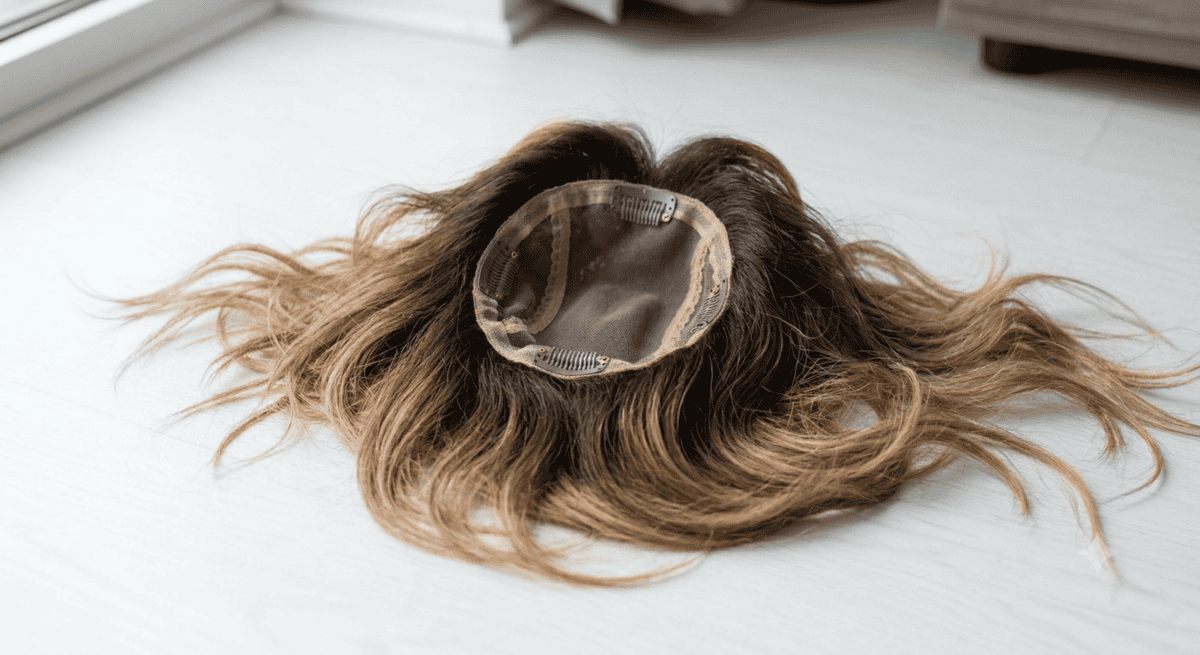
Clip-in hair toppers attach with small combs or clips that grip a section of your own hair and hold the weight of the piece. If you clip into the exact same sections every single day, that hair carries constant tension and eventually gives up. This is traction, the same mechanism behind tight ponytails and heavy extensions. It shows up first as soreness at the clip sites, then as thinning in those specific spots. Caught early it is usually reversible. Left alone for long enough it might not be.
Two things prevent almost all of it. Move where you clip in every time you wear it, and add texture product to the hair at the clip sites so the clips grip without dragging. That’s the whole answer. The rest of this post is me explaining how I learned it the slow way.
What actually did the damage (it wasn’t the topper)
I want to be really clear about this, because I think a lot of women give up on toppers for the wrong reason.
The piece itself sits on top. It’s light. Mine have never been heavy enough to be the problem. What caused my soreness was that I was a creature of habit. I clipped in the same way every morning, front two clips in the same spots, back clip in the same spot, because that’s where they went and I wasn’t thinking about it. Muscle memory. Six seconds and out the door.
So the same little sections of my hair were taking the entire pull, every day, for months.
My hair is thin and fine to begin with, which meant those sections had less to give than they would on someone with thick hair. Before I changed anything, the clips tugged a lot and I did lose hair from frequent use. Not dramatically. Not all at once. Just enough that I noticed when I finally looked properly, and enough that I felt genuinely stupid for not connecting the soreness to what was going on. If you want the full list of things I got wrong in those early years, they’re all in the hair topper mistakes I made so you don’t have to.
The first thing I changed, and honestly the one that matters most
I stopped clipping into the same spots.
That’s it. Every time I put the topper on, I moved the clips. Half an inch forward, half an inch back, slightly wider, slightly narrower. Never a rule about it, just never the same twice in a row.
It sounds too simple to be the fix. It was the fix. The soreness went within a couple of weeks and it never properly came back, across years of wearing alternative hair.
If you take one thing from this post, take that. Not a product. Not a special clip. Just refusing to be on autopilot for the ten seconds it takes to put your hair on.
The second thing: give the clips something to hold on to
Fine hair is slippery. Slippery hair means the clip doesn’t grip, and a clip that doesn’t grip slides, and a clip that slides drags your hair with it all day long. That dragging is what you feel at 4pm.
So I started spraying texturising spray directly onto the sections where the clips were going. Not all over. Just those bits. Dry shampoo does the same job, hairspray works too, whatever you already own.
The difference was immediate. The clips sat where I put them and stayed there, which meant no repositioning, no tugging, and no walking around all day with a tiny hair emergency happening on my scalp. It also fixed a slipping problem I’d been blaming on the topper for ages. (I wrote a whole separate post on why your hair topper keeps sliding, because it turns out most of it is grip, not the piece.)
The base size problem nobody connects to damage
Here’s one that took me longer to spot. If your base is too small for your actual area of hair loss, the clips end up landing on hair that’s already thin and fragile, right at the edge of where you need coverage. That hair is the least equipped to take the tension, and it’s also the hair you most need to keep.
A base with a bit of room around your thinning area means the clips land on stronger hair further out. Most retailer sizing guides suggest leaving somewhere between half an inch and a full inch of buffer beyond the area you’re covering, and the reason they give is exactly this. Some of them do spell it out, and one I came across names traction alopecia outright. The problem isn’t that nobody says it. It’s where they put it. It lives in the sizing guide, which is the page you read after you’ve already picked the wrong size, if you read it at all. If you’re not sure what size you actually need, start with how to measure your hair loss area for a hair topper.
So if you’ve got soreness and you’ve already tried moving your clips, look at your base size before you look at anything else.
Snap clips, pressure-sensitive clips, and the difference that actually matters
Something I got wrong for years, and I only worked it out because I bought a cheap topper and could feel the difference the first morning I wore it.
Not all clips are the same. But go looking online and you’ll find people comparing “snap clips” against “pressure-sensitive clips” like they’re two separate products, and I fell for it, and I repeated it, and it’s rubbish. Same clip. Small metal thing with comb teeth, press to shut, squeeze to open. I spent years thinking I’d worn both kinds and what I’d actually done was buy the same clip twice with different words on the packaging.
The difference that does exist is silicone. Some clips have a strip of it bonded to the flat side, the bit that sits against your head. Some don’t. My cheap toppers came with bare metal and my better ones didn’t.
The silicone isn’t what’s holding onto your hair, the teeth are still doing that job. It’s there to stop the clip itself wandering off once it’s shut, and to sit a bit softer against your scalp. The snap action is identical either way.
So why do I care this much about a strip of rubber? Because my hair is fine and slippery, an unlined clip on fine hair does not stay where you put it, it creeps, and that creeping is the exact dragging I was describing earlier, the thing you can feel at four in the afternoon and can’t do anything about because you’re at work.
Which means the silicone lining and my texturising spray have been quietly working on the same problem from opposite ends this whole time. One roughs up my hair so the clip can hold. The other roughs up the clip so it holds my hair.
Now the part I don’t want to skip, because I’d hate anyone to read this and think they can buy their way out of it. Silicone stops the clip moving. It doesn’t reduce how hard those teeth pull on that section. A clip that grips beautifully and doesn’t budge all day is still a clip holding a hairpiece on one small patch of your head, and if you put it back in the same spot tomorrow you’ve still got the whole problem. Rotation is what actually protects you. The good clip just makes the day less annoying.
Last thing, useful if you ever get clips replaced or sewn onto a piece yourself. Clip size is supposed to change with position: smaller ones near your temples and sides, bigger ones round the back perimeter. You can also get wider clips with more teeth, sold on the basis that spreading the grip across a broader area distributes the tension better. Which is my whole argument about rotation, except somebody built it into the hardware.
What I don’t do
I never sleep in a topper. Not once, not on holiday, not when I’ve come home too tired to care. Eight hours of a clip pulling in one direction while your head moves around on a pillow is the exact thing I’ve spent this whole post telling you to avoid.
I also started working wigs into the rotation, partly because I liked them and partly because a wig gives my head a complete break from clips. Some days there was nothing gripping my own hair at all. I didn’t plan that as a damage strategy, it just turned out to be one. If you’re weighing the two up, I’ve written about hair topper vs wig and which one you actually need.
Then I shaved my head.
Not as a rescue mission, and I want to be clear about that, because I can already hear someone reading this and panicking. It wasn’t damage that did it. I’m growing my hair back out and I wanted to start from actual zero instead of from years of thinning and faded ends I’d been babying along. So right now I’m in wigs full time and there is nothing clipping into anything.
Which is a genuinely odd thing to be typing in a post about protecting the hair your clips sit on. But there it is. The woman telling you how to look after your clip sites currently has no clip sites, and I’d rather say that out loud than write this like I’m still living it day to day.
Did the hair grow back?
Yes. I caught it in time and it grew back.
I’m not going to pretend that’s a guarantee, because it isn’t. Traction damage that’s been going on for years can become permanent, and I got lucky in the sense that I noticed while it was still just soreness and a bit of thinning rather than bald patches. My hair is thin and fine overall and always has been, so it’s not like I ended up with a triumphant before-and-after. It just stopped getting worse and filled back in.
And I want to correct something, because I nearly wrote this post as though I’d cleverly worked it all out on my own. I didn’t. I learned it from other topper wearers on Instagram. That community is genuinely one of the most helpful corners of the internet I’ve ever stumbled into, full of women who’ve already made every mistake you’re about to make and will tell you about it in your DMs at eleven at night without a hint of judgement. (If you’re not in it yet, come and find me at @neveen.wood. That’s the hair loss side of my Instagram and it’s where I still am.)
What I did not get was any of it from a professional. No hairdresser, no doctor, nobody at the point of sale ever mentioned clip tension to me. The people who saved my hair were other women wearing the same pieces I was.
Which is not me telling you to skip the professionals, and I want to be careful here because I’m not one. If the soreness doesn’t settle once you’ve changed how you’re clipping in, or you can see actual bare patches where the clips sit, get it looked at properly by a GP or a trichologist. I just wouldn’t sit around waiting for one of them to raise it with you first, because mine never did.
So, do hair toppers damage your hair?
They can. There’s no guarantee you’ll get away with zero damage, and I’d be lying to you if I said otherwise.
But there are ways to mitigate it, and after years of wearing toppers nearly every day, mine have worked. Move your clips every single time. Put texture product where the clips go. Get a base with enough room that the clips aren’t landing on your most fragile hair. Take them off at night. Give your head a rest day when you can.
Would I go back and do it differently from the start? Obviously. Would I stop wearing toppers because of what happened? Not a chance. I got years of leaving the house feeling like myself out of them, and the cost of that turned out to be about ten seconds of attention a day, once I knew where to put it. If you’re at the beginning of all this, here’s what I’d tell myself at the start.
Frequently asked questions
Do hair toppers damage your hair?
They can, but the topper is not usually what does it. The damage comes from clip tension when the clips go into the same sections of hair every time you wear it. Rotating clip positions on each wear and adding texture product where the clips sit prevents most of it.
Can hair toppers cause traction alopecia?
Yes, if the clips pull on the same hair constantly over a long period. Traction alopecia is hair loss caused by sustained tension, and clip-in pieces can cause it in the same way tight ponytails and heavy extensions can. The early signs are soreness and thinning at the clip sites.
Does hair grow back after hair topper damage?
Often, if it is caught early. Hair lost to clip tension can regrow once the tension stops, which is what happened in my case. Traction damage left in place for years is more likely to become permanent, so persistent soreness or visible bare patches are worth getting checked by a GP or trichologist.
How do you stop hair topper clips from damaging hair?
Move the clips to slightly different positions every time you put the piece on, apply texturising spray or dry shampoo to the sections where the clips grip, choose a base size with room around your thinning area, and never sleep in it.
Do silicone-lined clips protect your hair better?
They help with slipping rather than with tension. A silicone-lined clip has a strip of silicone on the flat side that stops the clip travelling once it is closed, which cuts down the dragging you get from bare metal clips on fine hair. The teeth still pull on the same section, so rotating clip positions matters far more than which clip you buy. Worth knowing: “snap clips” and “pressure-sensitive clips” are two names for the same clip, not two different products.
Can you wear a hair topper every day?
Yes, with care. Daily wear is manageable if the clip positions change on each wear and the piece comes off at night. Alternating with a wig gives the clip areas a complete rest.
Google will show you more of my posts when you search, AI answers included. One tap, and you can undo it any time.