Get my newsletter
One email every Friday with new posts, what's new in beauty, wigs and toppers, beauty deals and my current discount codes.
It's free and you can unsubscribe any time.
How it works, FAQs and sources
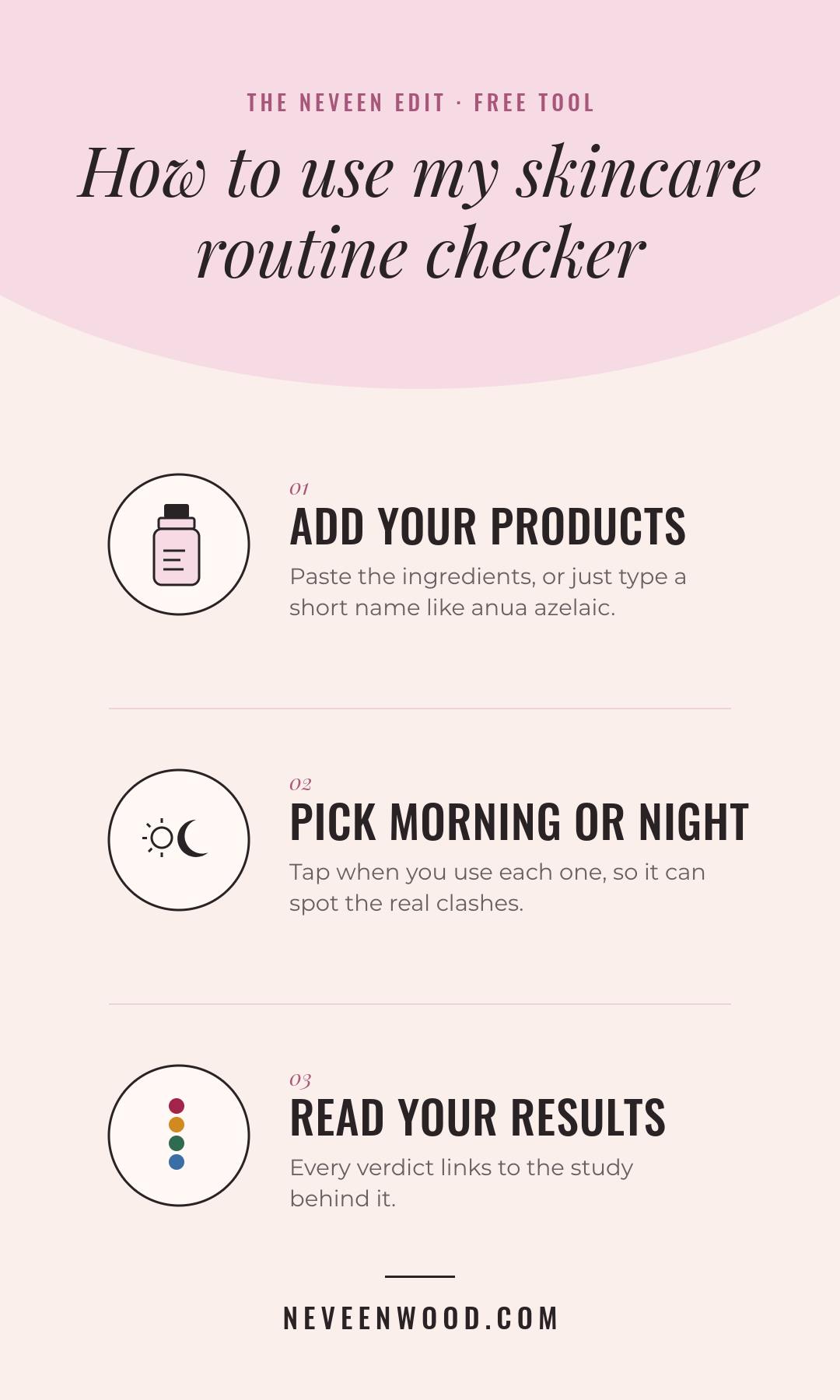
Pop in your products (paste the ingredients, or just type a short name like "anua azelaic") and pick morning, night or both for each one. Hit check and it tells you what's fine together and what's better split between morning and night. It'll also flag it when you've doubled up on something, and put your routine in order for you.
Red means don't mix. Amber means split them or go slowly, green is fine together and blue means they actually help each other. Grey is for doubling up.
Every warning comes with the study behind it. If you use prescription skincare, your prescriber has the final say.
Skincare routine checker questions
Can you use retinol and vitamin C together?
Yes, you can use both in the same routine. The easy way is vitamin C in the morning under your sunscreen and retinol at night. Vitamin C under sunscreen actually gives you extra protection (study), and retinol is usually a night product anyway, so splitting them just makes sense.
Can you use niacinamide and vitamin C together?
Yes. The "never mix them" warning comes from old tests on pure ingredients in a lab, and it doesn't apply to the serums we use now. A 60-woman trial used a serum with niacinamide, vitamin C and tranexamic acid all together, and it worked and was well tolerated (study).
Can you use retinol and niacinamide together?
There's no known problem with these two. Lots of retinol serums already have niacinamide in them (CeraVe's Resurfacing Retinol Serum is one), because niacinamide is calming and plays nicely with almost everything (study).
What really shouldn't be mixed?
Two pairs to keep apart. Prescription tretinoin with benzoyl peroxide, because benzoyl peroxide breaks tretinoin down (study). And dapsone gel (Aczone) with benzoyl peroxide, which can stain skin and hair orange (study). Stacking a retinoid with a strong acid on the same night is worth avoiding too, since that's a fast route to red, peeling skin.
Sources the checker is built on
Every warning and tip in the checker comes from one of these. Tap the button to see them all.
Show all 109 sources
What not to mix
- Torok HM, Pillai R. Safety and efficacy of micronized tretinoin gel (0.05%) in treating adolescent acne. Journal of Drugs in Dermatology, 2011 - benzoyl peroxide breaking tretinoin down
- Singh R and colleagues. Review of tretinoin-benzoyl peroxide in the treatment of acne vulgaris. Journal of Drugs in Dermatology, 2022 - why the two only work together in a special encapsulated cream
- Dubina MI, Fleischer AB. Interaction of topical sulfacetamide and topical dapsone with benzoyl peroxide. Archives of Dermatology, 2009 - the orange-brown staining
- Rendon M and colleagues. Successful treatment of moderate to severe melasma with triple-combination cream and glycolic acid peels: a pilot study. Cutis, 2008 - spacing retinoids and acids out
- Fang Y and colleagues. Mitigation of retinol-induced skin irritation by physiologic lipids: evidence from patch testing. Journal of Cosmetic Dermatology, 2024 - a moisturiser to calm retinol sting
- Tashtoush BM, Jacobson EL, Jacobson MK. UVA is the major contributor to the photodegradation of tretinoin and isotretinoin. International Journal of Pharmaceutics, 2008 - why retinoids are a night step
What works well together
- Rocio J and colleagues. Evaluation of the efficacy of a serum containing niacinamide, tranexamic acid, vitamin C, and hydroxy acid compared to 4% hydroquinone in the management of melasma. Journal of Cosmetic Dermatology, 2025 - niacinamide and vitamin C together
- Murray JC and colleagues. A topical antioxidant solution containing vitamins C and E stabilized by ferulic acid provides protection for human skin against damage caused by ultraviolet irradiation. Journal of the American Academy of Dermatology, 2008 - vitamin C under sunscreen
- Handler M and colleagues. Facial aging improvement case study using a novel combination of retinol, niacinamide, and Terminalia chebula. Journal of Drugs in Dermatology, 2022 - retinol and niacinamide together
- Tempark T, Shem A, Lueangarun S. Efficacy of ceramides and niacinamide-containing moisturizer versus hydrophilic cream in combination with topical anti-acne treatment. Journal of Cosmetic Dermatology, 2024 - niacinamide alongside retinoids
Sun sensitivity and doubling up
- Kaidbey K and colleagues. Topical glycolic acid enhances photodamage by ultraviolet light. Photodermatology, Photoimmunology and Photomedicine, 2003 - acids and sun sensitivity
- Hakozaki T and colleagues. The effect of niacinamide on reducing cutaneous pigmentation and suppression of melanosome transfer. British Journal of Dermatology, 2002 - the 2% and 5% niacinamide amounts
- Pinnell SR and colleagues. Topical L-ascorbic acid: percutaneous absorption studies. Dermatologic Surgery, 2001 - why one vitamin C is enough
- Petersen B, Wulf HC. Application of sunscreen: theory and reality. Photodermatology, Photoimmunology and Photomedicine, 2014 - sunscreen as the last morning step, and using enough
Dark spot pairings
- Gonzalez-Molina V and colleagues. Topical treatments for melasma and their mechanism of action. Journal of Clinical and Aesthetic Dermatology, 2022 - how the dark spot ingredients work together
- Austin E, Nguyen JK, Jagdeo J. Topical treatments for melasma: a systematic review of randomized controlled trials. Journal of Drugs in Dermatology, 2019 - dark spot ingredients in trials
- Arellano I and colleagues. Preventing melasma recurrence: prescribing a maintenance regimen with an effective triple combination cream. Journal of the European Academy of Dermatology and Venereology, 2012 - hydroquinone and tretinoin in one cream
- McKesey J, Tovar-Garza A, Pandya AG. Melasma treatment: an evidence-based review. American Journal of Clinical Dermatology, 2020 - which dark spot combinations have evidence
- Neagu N and colleagues. Melasma treatment: a systematic review. Journal of Dermatological Treatment, 2022 - combining dark spot treatments
- Ghasemiyeh P and colleagues. Safety and efficacy of niosomal and conventional tranexamic acid/niacinamide vs. hydroquinone creams in melasma. Scientific Reports, 2025 - tranexamic acid and niacinamide together
- Suliman RS and colleagues. Emerging topical therapies for melasma: a comparative analysis of efficacy and safety. Journal of Dermatological Treatment, 2025 - newer dark spot ingredients
- Calacattawi R and colleagues. Tranexamic acid as a therapeutic option for melasma management: meta-analysis and systematic review of randomized controlled trials. Journal of Dermatological Treatment, 2024 - how much tranexamic acid helps
- Philipp-Dormston WG. Melasma: a step-by-step approach towards a multimodal combination therapy. Clinical, Cosmetic and Investigational Dermatology, 2024 - layering dark spot ingredients
- Hu S and colleagues. Emerging topical therapies to treat pigmentary disorders: an evidence-based approach. Journal of Dermatological Treatment, 2022 - over-the-counter brightening ingredients
- Tan MG and colleagues. Topical treatment for postinflammatory hyperpigmentation: a systematic review. Journal of Dermatological Treatment, 2022 - treating marks left after spots
- Davis EC, Callender VD. Postinflammatory hyperpigmentation: a review of the epidemiology, clinical features, and treatment options in skin of color. Journal of Clinical and Aesthetic Dermatology, 2010 - dark marks in darker skin tones
Acne pairings
- Reynolds RV and colleagues. Guidelines of care for the management of acne vulgaris. Journal of the American Academy of Dermatology, 2024 - the main acne guidelines, including which treatments get combined
- Yang Z and colleagues. Topical benzoyl peroxide for acne. Cochrane Database of Systematic Reviews, 2020 - benzoyl peroxide and what it's paired with
- Stein Gold L and colleagues. Efficacy and safety of a fixed-dose clindamycin phosphate 1.2%, benzoyl peroxide 3.1%, and adapalene 0.15% gel for moderate-to-severe acne. American Journal of Clinical Dermatology, 2022 - adapalene and benzoyl peroxide together
- Callender VD and colleagues. Efficacy and safety of fixed-dose clindamycin phosphate 1.2%/adapalene 0.15%/benzoyl peroxide 3.1% gel in Hispanic participants with moderate-to-severe acne. Journal of Dermatological Treatment, 2025 - the same combination in more skin types
- Purdy S, de Berker D. Acne vulgaris. BMJ Clinical Evidence, 2011 - azelaic acid alongside retinoids
- Liu H and colleagues. Topical azelaic acid, salicylic acid, nicotinamide, sulphur, zinc and fruit acid (alpha-hydroxy acid) for acne. Cochrane Database of Systematic Reviews, 2020 - azelaic acid, salicylic acid and niacinamide
- Walocko FM and colleagues. The role of nicotinamide in acne treatment. Dermatologic Therapy, 2017 - niacinamide alongside acne treatments
- Petrovici AG and colleagues. A comprehensive review of azelaic acid pharmacological properties, clinical applications, and innovative topical formulations. Pharmaceuticals, 2025 - azelaic acid and what it pairs with
Retinoids and anti-ageing
- Kolli SS and colleagues. Topical retinoids in acne vulgaris: a systematic review. American Journal of Clinical Dermatology, 2019 - how irritating retinoids can be
- Mambwe B and colleagues. Cosmetic retinoid use in photoaged skin: a review of the compounds, their use and mechanisms of action. International Journal of Cosmetic Science, 2025 - retinol, retinal and the other cosmetic retinoids
- Kwon HS and colleagues. Efficacy and safety of retinaldehyde 0.1% and 0.05% creams used to treat photoaged skin: a randomized double-blind controlled trial. Journal of Cosmetic Dermatology, 2018 - retinal and how well it's tolerated
- Siddiqui Z and colleagues. Comparing tretinoin to other topical therapies in the treatment of skin photoaging: a systematic review. American Journal of Clinical Dermatology, 2024 - retinoids next to vitamin C and other anti-ageing ingredients
- Lin L and colleagues. Comparative efficacy of topical interventions for facial photoaging: a network meta-analysis. Scientific Reports, 2025 - how retinoids, vitamin C and niacinamide compare
- Dhaliwal S and colleagues. Prospective, randomized, double-blind assessment of topical bakuchiol and retinol for facial photoageing. British Journal of Dermatology, 2019 - bakuchiol and retinol doing a similar job
- Puyana C, Chandan N, Tsoukas M. Applications of bakuchiol in dermatology: systematic review of the literature. Journal of Cosmetic Dermatology, 2022 - what bakuchiol does
- Draelos ZD and colleagues. Clinical evaluation of a nature-based bakuchiol anti-aging moisturizer for sensitive skin. Journal of Drugs in Dermatology, 2020 - bakuchiol for skin that can't take retinoids
Exfoliating acids
- Sharad J. Glycolic acid peel therapy: a current review. Clinical, Cosmetic and Investigational Dermatology, 2013 - glycolic acid and why it can sting
- Kessler E and colleagues. Comparison of alpha- and beta-hydroxy acid chemical peels in the treatment of mild to moderately severe facial acne vulgaris. Dermatologic Surgery, 2008 - AHAs and BHAs side by side
Vitamin C and sunscreen
- Correia G, Magina S. Efficacy of topical vitamin C in melasma and photoaging: a systematic review. Journal of Cosmetic Dermatology, 2023 - what vitamin C actually does
- Lin FH and colleagues. Ferulic acid stabilizes a solution of vitamins C and E and doubles its photoprotection of skin. Journal of Investigative Dermatology, 2005 - vitamin C with vitamin E and ferulic acid
- Hughes MCB and colleagues. Sunscreen and prevention of skin aging: a randomized trial. Annals of Internal Medicine, 2013 - daily sunscreen and skin ageing
- Seite S, Fourtanier AMA. The benefit of daily photoprotection. Journal of the American Academy of Dermatology, 2008 - everyday sun protection
- Alvarez GV and colleagues. Skincare ingredients recommended by cosmetic dermatologists: a Delphi consensus study. Journal of the American Academy of Dermatology, 2025 - which ingredients dermatologists recommend for what
Moisturisers and gentler routines
- Draelos ZD and colleagues. Ceramide-containing adjunctive skin care for skin barrier restoration during acne vulgaris treatment. Journal of Drugs in Dermatology, 2023 - a moisturiser to protect your barrier during acne treatment
- Nakra G and colleagues. Real-world evaluation of the Episoft AC moisturizer with broad-spectrum sunscreen in the management of retinoid-induced dermatitis. Cureus, 2026 - moisturiser and sunscreen alongside retinoids
- Loden M. Role of topical emollients and moisturizers in the treatment of dry skin barrier disorders. American Journal of Clinical Dermatology, 2003 - why a moisturiser helps
- Thiboutot D, Thieroff-Ekerdt R, Graupe K. Efficacy and safety of azelaic acid (15%) gel as a new treatment for papulopustular rosacea. Journal of the American Academy of Dermatology, 2003 - azelaic acid and its tingle
Pregnancy
- Rau A, Keri J, Murase JE. Management of acne in pregnancy. American Journal of Clinical Dermatology, 2024 - retinoids in pregnancy
More on dark spots
- Tantanasrigul P, Sripha A, Chongmelaxme B. The efficacy of topical cosmetic containing alpha-arbutin 5% and kojic acid 2% compared with triple combination cream for the treatment of melasma. Journal of Cosmetic Dermatology, 2025 - arbutin and kojic acid together
- Gabhane M and colleagues. Efficacy and safety of a topical formulation containing trihydroxybenzoic acid glucoside and alpha-arbutin, applied along with a sunscreen. Journal of Cosmetic Dermatology, 2025 - arbutin used with daily sunscreen
- Sarkar R and colleagues. Topical and systemic therapies in melasma: a systematic review. Indian Dermatology Online Journal, 2023 - kojic acid and other brighteners
- Gonzalez N, Perez M. Natural cosmeceutical ingredients for hyperpigmentation. Journal of Drugs in Dermatology, 2016 - arbutin, kojic acid and other gentler brighteners
- Sarkar R and colleagues. Glutathione as a skin-lightening agent and in melasma: a systematic review. International Journal of Dermatology, 2025 - what glutathione does for dark spots
- Jeon H and colleagues. Enhanced skin permeation and pigmentation reduction effects of a novel tranexamic acid-mandelic acid ion-pairing complex. Skin Research and Technology, 2025 - tranexamic acid paired with an acid
- Wang YJ and colleagues. Prospective randomized controlled trial comparing treatment efficacy and tolerance of picosecond alexandrite laser with a diffractive lens array and triple combination cream in female Asian patients with melasma. Journal of the European Academy of Dermatology and Venereology, 2020 - hydroquinone and tretinoin cream results
- Charoo NA. Hyperpigmentation: looking beyond hydroquinone. Journal of Cosmetic Dermatology, 2022 - hydroquinone risks with long use
- Dadzie OE, Petit A. Skin bleaching: highlighting the misuse of cutaneous depigmenting agents. Journal of the European Academy of Dermatology and Venereology, 2009 - why hydroquinone needs a prescriber
More on acne and redness
- Akarsu S and colleagues. Efficacy of the addition of salicylic acid to clindamycin and benzoyl peroxide combination for acne vulgaris. Journal of Dermatology, 2012 - salicylic acid with benzoyl peroxide
- Bowe WP, Shalita AR. Effective over-the-counter acne treatments. Seminars in Cutaneous Medicine and Surgery, 2008 - shop-bought acne actives and how they pair
- Andres P, Pernin C, Poncet M. Adapalene-benzoyl peroxide once-daily, fixed-dose combination gel: a randomized split-face dose-assessment study of cutaneous tolerability. Cutis, 2008 - how well that pairing is tolerated
- Ye Y and colleagues. Efficacy and safety of Melaleuca alternifolia (tea tree) oil for acne: a systematic review and meta-analysis. Phytotherapy Research, 2026 - tea tree oil, what it does and its side effects
- Kairey L and colleagues. Efficacy and safety of Melaleuca alternifolia (tea tree) oil for human health: a systematic review of randomized controlled trials. Frontiers in Pharmacology, 2023 - tea tree oil irritation
- Cao H and colleagues. Complementary therapies for acne vulgaris. Cochrane Database of Systematic Reviews, 2015 - tea tree and other natural acne options
- Yee BE and colleagues. Serum zinc levels and efficacy of zinc treatment in acne vulgaris: a systematic review and meta-analysis. Dermatologic Therapy, 2020 - zinc for spots
- Brandt S. The clinical effects of zinc as a topical or oral agent on the clinical response and pathophysiologic mechanisms of acne. Journal of Drugs in Dermatology, 2013 - topical zinc
- van Zuuren EJ and colleagues. Effective and evidence-based management strategies for rosacea: summary of a Cochrane systematic review. British Journal of Dermatology, 2011 - azelaic acid and sulphur for rosacea
- Sharma A and colleagues. Rosacea management: a comprehensive review. Journal of Cosmetic Dermatology, 2022 - gentle rosacea routines, including sulphur
- Hua NJ and colleagues. Efficacy of treatments in reducing facial erythema in rosacea: a systematic review. Journal of Cutaneous Medicine and Surgery, 2025 - what calms rosacea redness
More on anti-ageing
- Imhof L, Leuthard D. Topical over-the-counter antiaging agents: an update and systematic review. Dermatology, 2021 - peptides and other shop-bought anti-ageing ingredients
- Chan LKW and colleagues. Cosmeceuticals in photoaging: a review. Skin Research and Technology, 2024 - the evidence behind popular anti-ageing ingredients
- Draelos Z, Bogdanowicz P, Saurat JH. Top weapons in skin aging and actives to target the consequences of skin cell senescence. Journal of the European Academy of Dermatology and Venereology, 2024 - which anti-ageing actives do what
- Draelos ZD and colleagues. International consensus on anti-aging dermocosmetics and skin care for clinical practice using the RAND/UCLA appropriateness method. Journal of Drugs in Dermatology, 2024 - how to build an anti-ageing routine
- Manriquez JJ, Majerson Gringberg D, Nicklas Diaz C. Wrinkles. BMJ Clinical Evidence, 2008 - retinoids, acids and sunscreen for wrinkles
- McDaniel DH and colleagues. Efficacy and tolerability of a double-conjugated retinoid cream vs 1.0% retinol cream or 0.025% tretinoin cream in subjects with mild to severe photoaging. Journal of Cosmetic Dermatology, 2017 - retinoid and acid in one gentle formula
- Bertin C and colleagues. Combined retinol-lactose-glycolic acid effects on photoaged skin: a double-blind placebo-controlled study. International Journal of Cosmetic Science, 2008 - retinol and glycolic acid made to work in one product
- Nguyen N and colleagues. A prospective, double-blinded, randomized head-to-head clinical trial of topical adapinoid (oleyl adapalenate) versus retinol. Skin Health and Disease, 2024 - how retinoids differ in irritation
Gentler acids
- Edison BL and colleagues. A polyhydroxy acid skin care regimen provides antiaging effects comparable to an alpha-hydroxyacid regimen. Cutis, 2004 - PHAs as a gentler acid
- Grimes PE and colleagues. The use of polyhydroxy acids (PHAs) in photoaged skin. Cutis, 2004 - why PHAs sting less
- Jarzabek-Perz S, Mucha P, Rotsztejn H. Corneometric evaluation of skin moisture after application of 10% and 30% gluconolactone. Skin Research and Technology, 2021 - gluconolactone and hydration
- Arif T. Salicylic acid as a peeling agent: a comprehensive review. Clinical, Cosmetic and Investigational Dermatology, 2015 - what salicylic acid does
Soothing and hydrating ingredients
- van Zuuren EJ, Fedorowicz Z, Arents BWM. Emollients and moisturizers for eczema: abridged Cochrane systematic review including GRADE assessments. British Journal of Dermatology, 2017 - what moisturisers actually do
- Wollenberg A, Barbarot S, Torrelo A. Basic emollients for xerosis cutis in atopic dermatitis: a review of clinical studies. International Journal of Dermatology, 2025 - glycerin, urea and other basic moisturising ingredients
- Kim HO and colleagues. Comprehensive approaches to diagnosis and treatment of sensitive skin. Annals of Dermatology, 2025 - looking after skin that reacts easily
- Draelos ZD and colleagues. Evaluation of the performance of a nature-based sensitive skin regimen in subjects with clinically diagnosed sensitive skin. Journal of Drugs in Dermatology, 2018 - a gentle routine for sensitive skin
- Ebner F and colleagues. Topical use of dexpanthenol in skin disorders. American Journal of Clinical Dermatology, 2002 - what panthenol does for skin
- Proksch E and colleagues. Topical use of dexpanthenol: a 70th anniversary article. Journal of Dermatological Treatment, 2017 - panthenol and barrier repair
- Su Z and colleagues. The effectiveness and safety of a skin care product with Centella asiatica leaf extract, ceramide NP, and panthenol in subjects with sensitive skin. Journal of Cosmetic Dermatology, 2025 - centella, ceramides and panthenol together
- Gao M and colleagues. Evaluation of the efficacy and safety of a panthenol-enriched mask for skin barrier recovery after facial laser treatment. Journal of Cosmetic Dermatology, 2025 - panthenol and centella calming irritated skin
- Witkowska K and colleagues. Topical application of Centella asiatica in wound healing: recent insights into mechanisms and clinical efficacy. Pharmaceutics, 2024 - what centella does
- Liu H and colleagues. Skin barrier repairing and anti-aging effects evaluation of a comprehensive topical regimen incorporating niacinamide, Pro-Xylane, and panthenol after PicoWay laser. Lasers in Medical Science, 2026 - niacinamide and panthenol together
- Kircik L and colleagues. One Acne: a holistic management approach to improve overall skin quality and treatment outcomes in acne with or without sensitive skin. International Journal of Dermatology, 2025 - soothing skincare alongside acne treatments
More on sunscreen and vitamin C
- Abdel Azim S and colleagues. Sunscreens part 1: mechanisms and efficacy. Journal of the American Academy of Dermatology, 2025 - how sunscreen protects
- Zhou C and colleagues. Guide to tinted sunscreens in skin of color. International Journal of Dermatology, 2024 - tinted sunscreen and dark spots
- Lyons AB and colleagues. Photoprotection beyond ultraviolet radiation: a review of tinted sunscreens. Journal of the American Academy of Dermatology, 2021 - visible light and tinted sunscreen
- Abdel Azim S, Whiting C, Friedman AJ. Attitudes on, practices, and recommendations for visible light protection amongst dermatology practitioners. Journal of Drugs in Dermatology, 2024 - iron oxides and visible light
- Enescu CD and colleagues. A review of topical vitamin C derivatives and their efficacy. Journal of Cosmetic Dermatology, 2022 - the different forms of vitamin C
- Berry K, Hallock K, Lam C. Photoaging and topical rejuvenation. Clinics in Plastic Surgery, 2023 - sunscreen and retinoids as the core routine
- Bissett DL. Common cosmeceuticals. Clinics in Dermatology, 2009 - vitamin C, niacinamide and other everyday actives
Fungal acne and seb derm
- Draelos ZD and colleagues. Malassezia folliculitis presentation, diagnosis, and treatment: a review of "fungal acne". Journal of Drugs in Dermatology, 2026 - oils and the yeast behind fungal acne
- Saunte DML, Gaitanis G, Hay RJ. Malassezia-associated skin diseases, the use of diagnostics and treatment. Frontiers in Cellular and Infection Microbiology, 2020 - seb derm and fungal acne share the same yeast
Pore-clogging ingredients
- Fulton JE Jr, Pay SR, Fulton JE 3rd. Comedogenicity of current therapeutic products, cosmetics, and ingredients in the rabbit ear. Journal of the American Academy of Dermatology, 1984 - which ingredients were found to clog pores
- Baek JH and colleagues. Early detection of microcomedones induced by cocoa butter using reflectance confocal microscopy. Journal of Cosmetic Dermatology, 2022 - cocoa butter on human skin
- Draelos ZD, DiNardo JC. A re-evaluation of the comedogenicity concept. Journal of the American Academy of Dermatology, 2006 - why a flag is a heads up, not a guarantee