
Before you spend hundreds of pounds on a topper, measure your hair loss area. Seriously. It takes two minutes and it will save you from ordering something that either doesn’t cover enough, peeks out past your own hair, or just sits completely wrong on your head. I can’t tell you how many people skip this step and end up disappointed.
Table of Contents
What You Need
A soft tape measure, the sewing kind not a metal DIY one. A mirror, ideally with another one behind you so you can actually see the top of your head. Good lighting. And something to write your measurements down with because you will forget them otherwise, trust me.
No tape measure? A piece of string and a ruler does the job perfectly well.
How to Measure Your Hair Loss Area: Step by Step
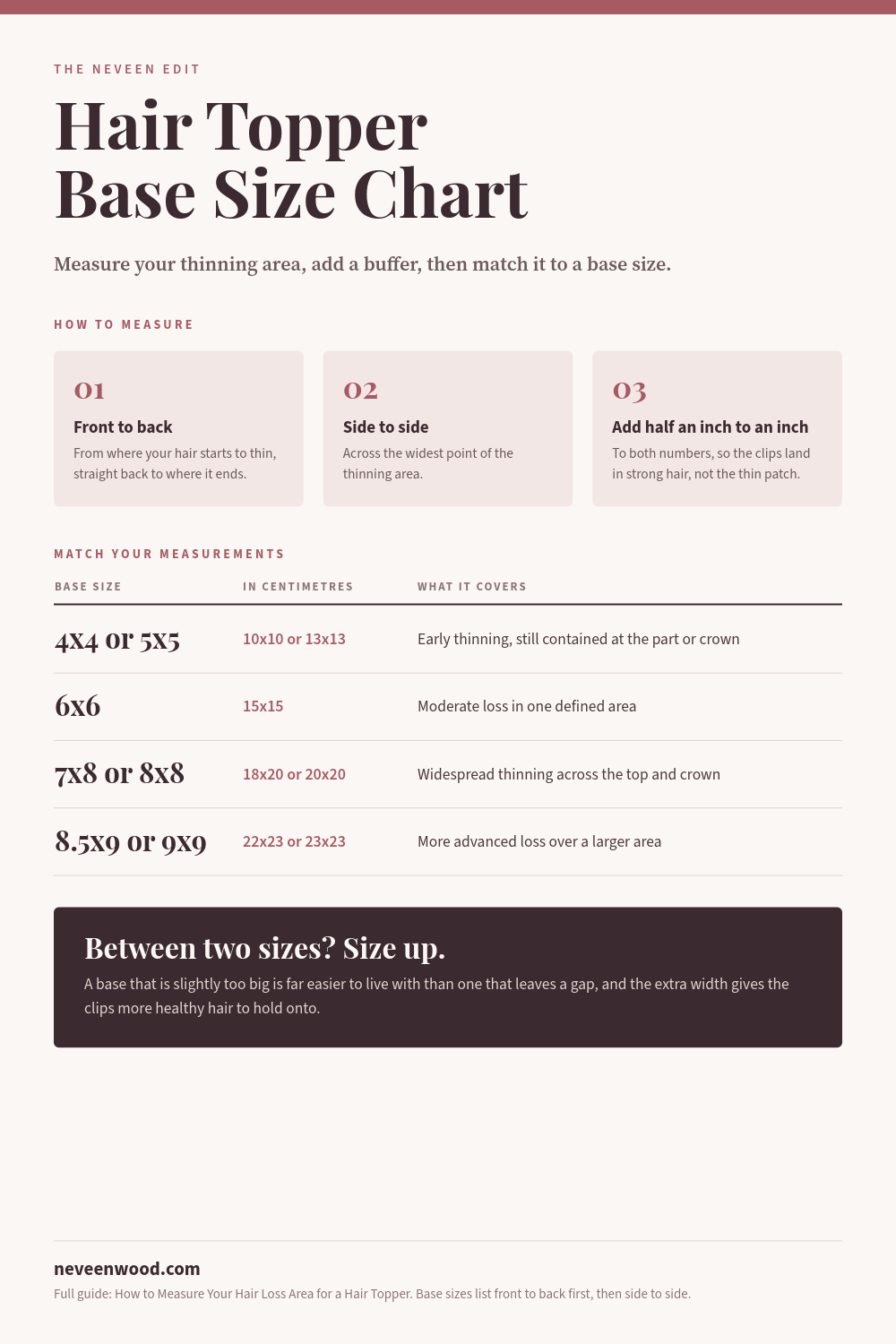
Topper bases come in two measurements: front to back, and side to side. So when you see something listed as 6×6 or 7×8, the first number is front to back (in inches) and the second is side to side. Simple once you know.
Step 1: Find where your thinning starts at the front. Look in the mirror and identify the point where your hair noticeably starts to thin. It’s usually an inch or two behind your natural hairline. Put the start of your tape measure there.
Step 2: Measure front to back. Run the tape straight back along the centre of your scalp to where the thinning ends. Write it down.
Step 3: Measure side to side. Measure across the widest point of your thinning area from one side to the other. Write that down too.
Step 4: Add a little buffer. I’d add half an inch to an inch to each measurement. This way your topper overlaps the thinning area slightly rather than meeting it exactly at the edge, which looks way more natural and means if the piece shifts a tiny bit during the day it’s not suddenly exposing a gap. The buffer is also what gets your clips into healthy, denser hair instead of gripping the thin patch, and that matters because clips pulling on fragile hair is how you end up damaging the hair you’ve still got.
Matching Your Measurements to a Base Size
Once you’ve got your measurements (with buffer), here’s roughly how they map to common base sizes:
4×4 or 5×5 – smaller, more targeted coverage. Early stage thinning at the crown.
6×6 – moderate loss that’s fairly contained to one area.
7×8 or 8×8 – more widespread thinning across the top and crown.
8.5×9 or 9×9 – more advanced loss that covers a larger area.
If your measurements sit between two sizes, go bigger. A slightly large base is so much more forgiving than one that doesn’t quite cover things.
One Thing to Keep in Mind with AGA
Androgenic Alopecia progresses slowly, which means your measurements now might not be your measurements in a year or two. It’s worth remeasuring every so often and keeping a note of where things are at. A lot of people find they gradually move up to a larger base size over time and that’s completely normal.
Once you’ve got your base size sorted, my Hair Topper vs Wig guide is a good next read if you’re still deciding which direction to go. And if you’re ready to start shopping, my discount codes page has all my current codes in one place.
FAQ
How do I measure my hair loss area for a hair topper?
Use a soft sewing tape measure. First measure front to back – start where your hair visibly begins to thin and measure back to where the thinning ends. Then measure side to side across the widest point of the thinning area. Add half an inch to an inch to each measurement as a buffer, so the clips land in denser hair rather than gripping the thinning area. The first number in a topper base size is front to back, the second is side to side.
What hair topper base size do I need?
Base size depends on your hair loss area once you’ve added the buffer. 4×4 or 5×5 suits early stage thinning at the crown. 6×6 suits moderate contained loss. 7×7, 7×8 or 8×8 suits more widespread thinning across the top and crown. 8.5×9 or 9×9 suits more advanced loss. For real-world reference, the pieces I own are a 7×7, a 7×8 and an 8.5×9, and that span covers moderate crown thinning through to quite a lot going on up there. If your measurements sit between two sizes, always go bigger.
What if I measure between two topper base sizes?
Always go with the larger size. A topper base that’s slightly too big is far easier to work with than one that doesn’t quite cover your thinning area. The extra coverage means the clips land in denser hair and the piece stays more secure.
Do I need to remeasure my hair loss area over time?
Yes, particularly with Androgenic Alopecia, which progresses gradually. It’s worth remeasuring every six to twelve months and noting any changes. Many people find they move up to a larger base size over time as their thinning area increases.
What is the difference between front-to-back and side-to-side on a topper base size?
When a topper is listed with two measurements like 7×8, the first number is the front-to-back measurement in inches and the second is the side-to-side measurement. These correspond to the dimensions of the base that sits on your scalp.
More Hair Topper Help
- Hair Topper vs Wig: Which One Do You Actually Need?
- How to Colour Match a Hair Topper or Wig
- The Hair Topper Mistakes I Made So You Don’t Have To
- Why Your Hair Topper Keeps Sliding (And What Actually Fixes It)
- Human Hair Topper and Wig Maintenance Routine
- Androgenic Alopecia in Women: What It Is, What to Expect and What Helps
- Hair Loss FAQ: Your Questions Answered
Get my newsletter
I send one email a week, every Friday. New posts, what’s new in beauty, wigs and toppers, beauty deals and my current discount codes. Sign up here, it’s free and you can unsubscribe any time.


